The A J Richter
CIVILIZATION COLLECTION
80
Despite the denials of unchecked innocence,
humanity is to one degree or another predatory
by nature, but to do no more than take issue
with this truth would be little better than denying
elephants are big. A J Richter

"It would be helpful as a species to find our limits before they find us".
... founded in 1984. The private collection designed to keep giving ....
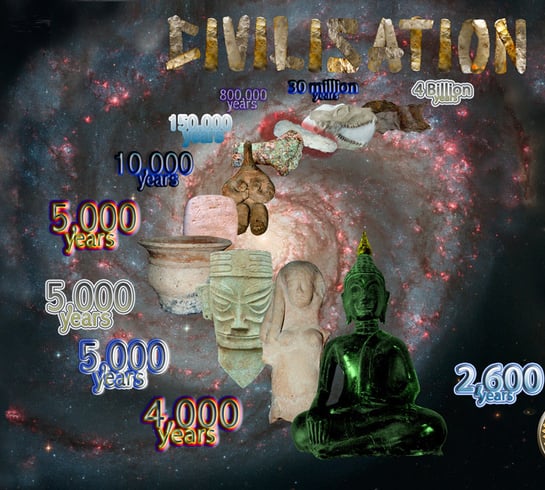
Now numbering close to 400 exhibits reaching back 11 thousand years into prehistory, with natural phenomena of meteorites and fossils that can be traced as far back as 3 Billion years, the collection now serves as a repository of civilization's footprints including perfect exhibits of the very first writing of Mankind.
This gathering of man's 'footprints' and those of the planet has achieved it's purpose: Those of us with an interest, or even obsession, to understand what life meant 'back then' can, through the intimacy of artifacts, better see people we wish to know more about.
Hal Colebatch Phd., an award-winning author of more than a dozen books, wrote about Anthony Richter and published the book under the title of 'RICHTER's LAWS'. Colebatch for his own reasons wrote the book as an unofficial biography. It should be said that Richter strenuously resisted the idea of a book about himself but was reminded that as a public figure he was 'fair game' meaning the book could be written with or without his blessing. Logically the book recounts Richter's rough intro-duction to Humanity. In fact his early meeting with Mankind was sufficiently demanding for the child it shaped his world view and personal philosophy for his lifetime. Colebatch recounted that in the early 1980's he had interviewed Richter for the Richter's Laws book research wanting to know how or why he [Richter], of all people had become a Private Collector.
Colebatch recalls "I was sufficiently familiar with Tony Richter to ask him quite directly what possible practical value could he find in the distant past or for that matter why he would indulge in what is normally reserved for the 'rich and idle'.
Colebatch added: I suggested to him that what remained of proto-civilizations was hardly more than dust and that any surviving artifacts were mostly of interest to dealers, black-market looters and museums ... some having knowingly purchased looted national heirlooms from famous auction houses.
Was he after all not just another of those with a lot of money buying wonderful treasures simply because they can?"

Colebatch was said by some to have a brain the size of a small planet. Fortunately Richter was familiar with abrupt journalists, no matter how clever. Richter: "Firstly I'll address the oftentimes negative press 'private collectors' get that is undeserved. For every collector acquiring 'treasures' of one kind or another ... perhaps for the gaining of attention, admiration or envy, there are more by far buying remarkable artifacts of antiquity purely for their beauty alone and or for education enrichment of themselves or others.
I know I am defending the seemingly indefensible but for those of us with depth greater than a Petrie dish, er, that is those of us that understand that beyond ownership there is the bonus of preserving objects that MAY have otherwise been 'lost' to us all".
The often unseen wonder of humanity is its astonishing diversity. Objects and artworks show the creative variation that are each unique expressions of countless cultures
Where they are thought useful, links to major museums or galleries are placed beside various exhibits to read of alternative interpretations of histories that may attach to the artifact we have chosen to display.


The Artifacts, objet d'Art, exhibits, artworks, seen in these pages are each parts of the CIVILIZATION COLLECTION and are the property of the Richter Civilization Trust. The Graphics, illustrations and artwork are original by A J Richter and inherent to the Collection.
Given the unfortunate absence of expertise from some 'experts', the building of this website necessitated an unpleasant return to the phenomenon of the Expert: Defined by me as 'a reliable source of data, informed thought and scholarly discourse'. It would be wrong to imply that the absence of expertise is the prevalent condition but opinions on matters of time, place, circumstance or causes in our distant past have too often been determined not by defensible data but by the present preference of an ill-informed opinionated speaker: Not what a thing is but 'what it should be'; Not where things were but 'where I expect them to be'.
Some may believe I have elevated myself to a place enabling me to judge what constitutes an expert when in fact the goal is to present markers or alerts that can be useful guides to whom you will listen to or read. Fortunately, I have the luxury of not needing to be an expert in this field and the experience to know who is. The one, and the only conclusion ever wholeheartedly agreed to by those interested in the topic of early Man is that there are civilizations we have yet to meet: Those that are almost certain to have existed as far back as we may wish to imagine. Special Note: Harvard Kennedy School (see Button link)
A remarkable achievement of experts:Report; July 27, 2023. In a Harvard Kennedy School survey of 150 academic experts in the United States on the issue of Misinformation was the conclusion that … “The most agreed-upon future direction for the field of Misinformation was to collect more data outside of the United States”.



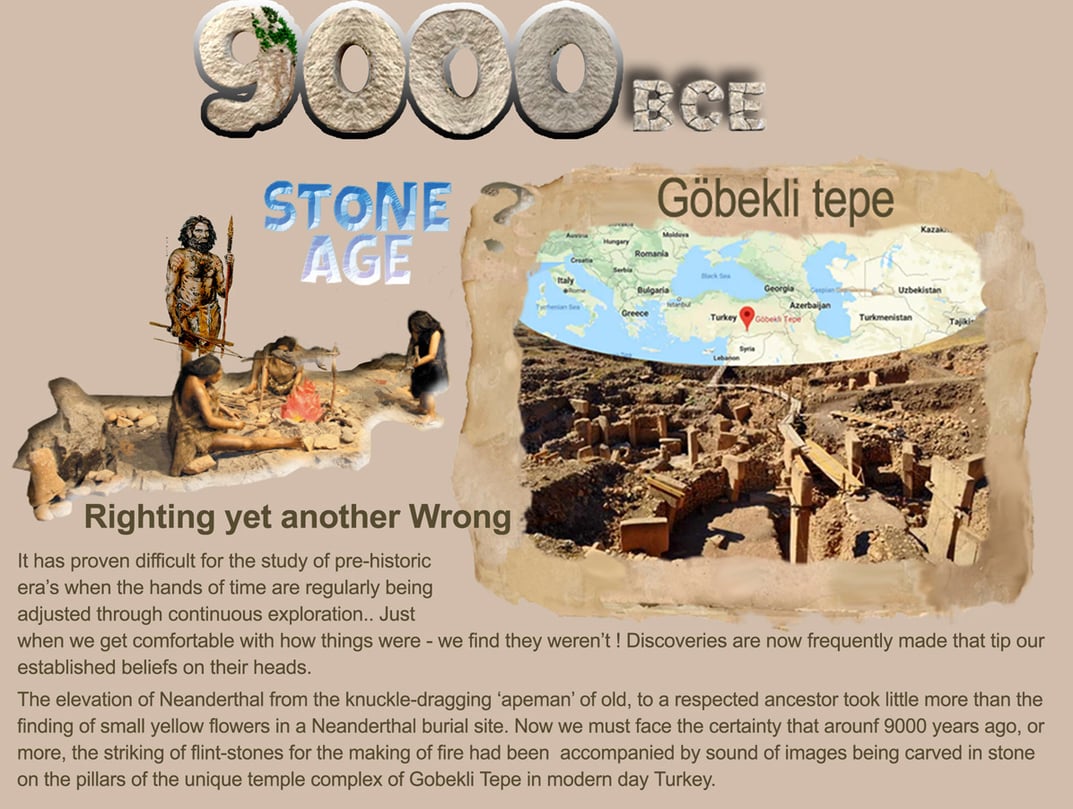
When thinking of ancient man, a comfortable jump and we land in a wonderful cave just as the family sink their collective teeth into a prime piece of Sabre-tooth Tiger. We have arrived in the very well known 'stone Age' in the year of a-long-time-ago. Cartoon features were made of the 'Rock Age' as long ago as the 1930's through to Betty and Barney Rubble ending in 1966. The Stone Age retains its unusual popularity due possibly to a pervasive error of 60 million years. So far as we can can tell Man has never seen a living Dinosaur. He has never eaten one nor has he ever ridden one.
Now, in pursuit of a higher level of education we stamp both feet outside the cave, causing two names to rise through the ancient sands: Paleolithic and Neolthic. Stones and Rocks 101. Lithic is what Greeks called rocks. Paleo is what separated a very old rock age from the Neo (think Matrix) much newer rock age. Just so we are clear: no stones had their ages changed nor at any time were by the demeaning title of 'pebbles" during the writing of this important work.
Even with that deep and meaningful dissertation - we still have a problem: At that so-called 'rock-ape' time it seems that not everyone dressed like Barney Rubble. Breaking News: 'Recent Discoveries' show that a nascent civilization of sorts was forming at Catalhoyak in modern day Turkey. That puts a proto-civilization on the same time-zone as true Stone Age people.


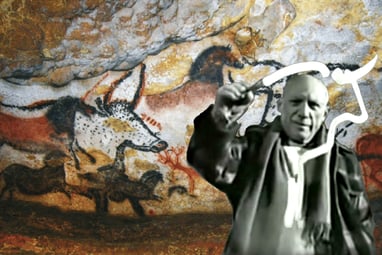
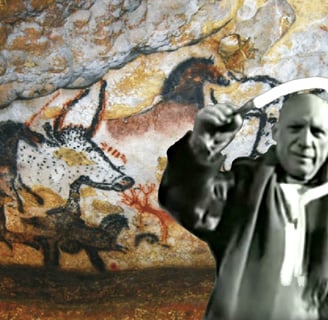
Lascaux Cave paintings Pablo picasso painting inserted
It seems unlikely that a writer would begin their expressions of a belief without leaving space on the page for doubt. My perceptions of humanity are presented in that way. I do realize that I, like countless others that are sufficiently foolish, bold or brash, to point out one or two of man's shortcomings will forevermore be reviewed as 'misanthropes' and the subject of endless ire: I give you my personal assurance I wouldn't do this if I didn't believe even that could be fun.
On having very often skirted the borders of 'Misanthropichood' I would on those occasions painstakingly research the most recent definitions of the 'title' misenthrope. Having done this for more than 55 years I am happy to report we have finally reached the milestone of having more definitions of a misanthrope than we have actual misanthropes. To my knowledge this is an achievement unparalleled for us or for any other presently known species.
As in all thought, balance is an ally. Contrasts in human ex- perience are legion. For Good we have Bad. For Hot there is Cold. For High - Low. I shall confidently leave the reader in command of the countless other antonyms. Before exploring the symbolism of my work 'The Paradigm' below, Mark Twain has by divine right to first observation.

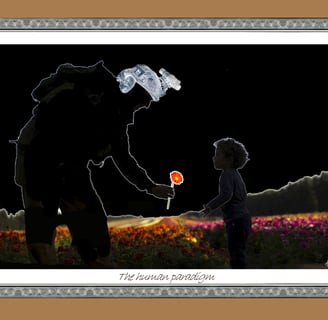
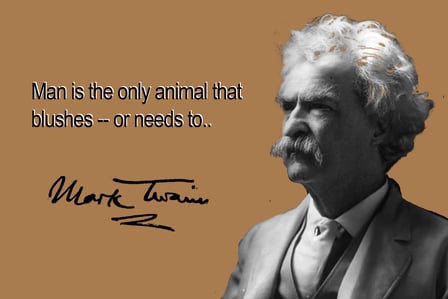
HUMANITY ... The Bad, the really bad, ...the good and the hurt.
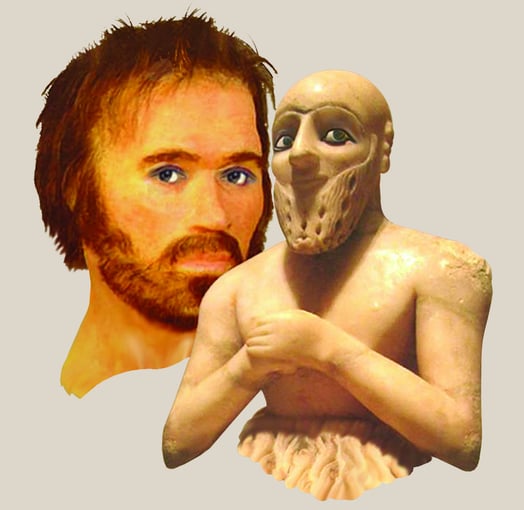
HOMO SAPIENS
a person of interest .....
HUMANITY DENIAL
"No man ever ended a war because he wanted to."
As a starting point of my efforts to better understand Homo Sapiens-sapiens it was essential to go beyond the nonsensical scribbling I had read from the National Institute of Wild-Eyed Guesses. For this reason and a personal drive to get a factual insight to our species true nature, I began the Civilization Collection.
The antiquity collection of over 400 exhibits represent Man's oldest known civilizations somewhat before humanity's first writing and onward. Times prior to the civilizations of Sumeria and those of the Indus Valley could be thought of as proto-civilizations beginning around 10,000 BCE. with the collection tapering at around 750 ACE. The collection has for me become a path of artifactual breadcrumbs: A path when followed gives an uncomfortably higher resolution image of mankind and the bumpy ride through civilizing.
Antiquities as data can often, and at times very accurately, reflect the evolving stages of a civilization. Through its written records, its conflicts and art there are intriguing periods of cultural transition that are visible in art, style, color texture and form of an art. It may be surprising to know I believe Picasso would be quite comfortable splashing out a 'bull or two' in the 20,000 year old gallery in the Lascaux caves in France. Not averse to publicity Picasso would definitely want a selfie.
In reading even this limited lauding of otherwise prosaic objects of the past, archaeologists and anthropologists of all stripes are choking back tears of professional dispair as they ponder the spectacle of an otherwise seemingly 'educated' person uttering such ill-informed banalities. What neither of these admirable professions will confess is how special they feel about being among the rarest few that will actually hold the artifacts of antiquity: To smell them, (many have odours) to touch them. How many of our increasing billions of fellow humans never have had or will ever have that experience. It is unfortunate to my mind that billions never see such wonders let alone feel them.

A J Richter Sept 9/2024